


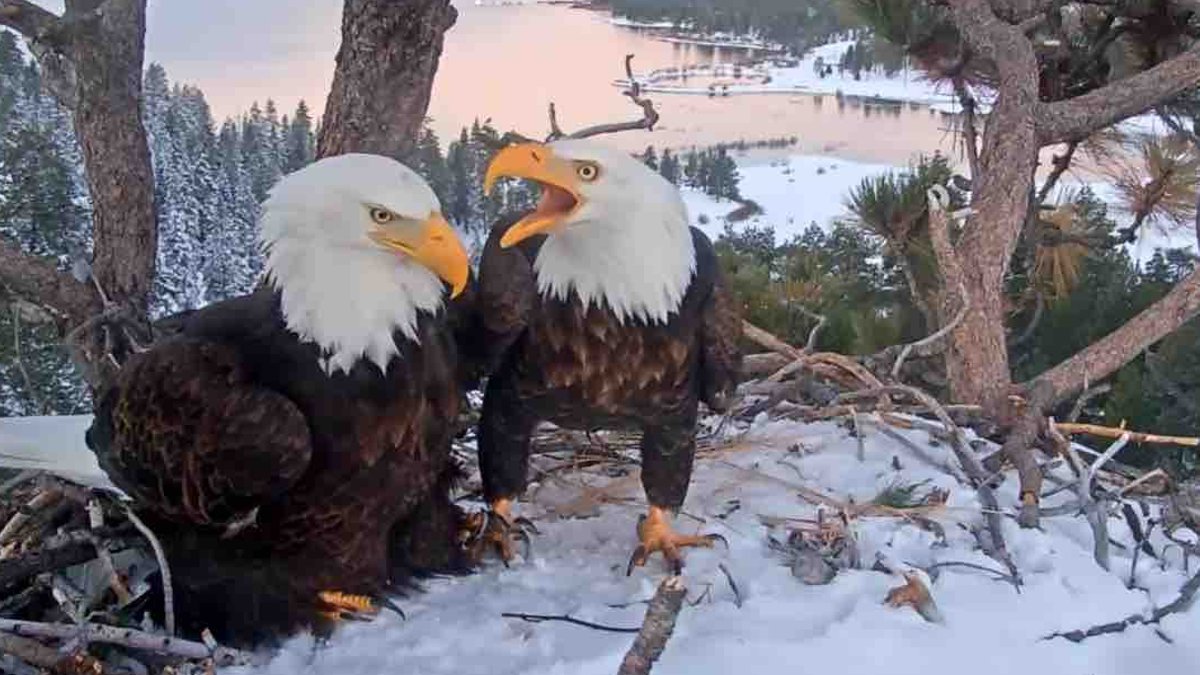
Jackie, the famous Big Bear bald eagle whose nest was watched by millions of people through a 24-hour livestream, died Monday after more than three weeks of intensive medical care for severe anemia and an illness whose underlying cause remained undetermined. She was about 14 years old.
The Ojai Raptor Center announced that Jackie, identified in veterinary records as Bald Eagle Patient 26-519, died in the early hours of Aug. 10 after her condition deteriorated despite intensive treatment, oxygen therapy and round-the-clock monitoring. Her remains were transferred to the California Department of Fish and Wildlife.
Jackie disappeared from the Big Bear Eagle Cam in mid-July after an apparent territorial encounter with other eagles. On July 17, an adult bald eagle was rescued after being found grounded and unable to fly near Big Bear Lake. Friends of Big Bear Valley initially said it could be Jackie but that her identity had not yet been confirmed. Video and photographic comparisons subsequently led the organization to conclude that the rescued bird was likely Jackie. She was transferred from San Dimas Raptor Rescue to the Ojai Raptor Center in Ojai, California, where veterinarians began an extensive diagnostic investigation.
Initial bloodwork showed severe anemia and inflammation affecting the kidneys. Jackie was critically ill but initially remained alert, ate with assistance and was able to perch. The medical team also investigated possible environmental and traumatic causes. Testing ruled out several suspected problems, including lead toxicosis and foreign objects such as fishing hooks, fishing line and weights. Her kidney inflammation subsequently appeared to improve, but the cause of the anemia remained unresolved.
Related: Trump’s Claims on Birthright Citizenship and Mining Fact-Checked
Jackie did not die simply because she was attacked by other eagles. The altercation appears to have preceded her rescue, but veterinarians determined that it did not explain the full extent of her medical condition. The central medical problem during her hospitalization was severe anemia, while the underlying reason for that anemia remained unknown.
Jackie received a blood transfusion using blood donated by another bald eagle, Spirit, from the California Living Museum in Bakersfield. The transfusion initially produced an encouraging response. Her packed cell volume, or PCV — a measurement of the proportion of blood made up of red blood cells — rose from 8% to 16% by July 27. But the improvement did not last. By Aug. 3, Jackie’s PCV had fallen to 13%. Days later, it dropped below 6%, an extremely serious level. On Aug. 9, the day before her death, her PCV had recovered slightly to 9%, but veterinarians said she remained critically ill and unstable.
The medical team included nine veterinarians as well as representatives from the U.S. Fish and Wildlife Service and California Department of Fish and Wildlife. Advanced diagnostic procedures, including CT imaging and a bone-marrow biopsy, were performed as veterinarians searched for an explanation. Despite those efforts, Jackie died in the early hours of Aug. 10.
The Ojai Raptor Center said it plans to provide more information about her treatments and test results. Her remains have been transferred to the California Department of Fish and Wildlife, meaning additional examination could potentially provide information about the cause of her illness. As of the latest available information, there is no confirmed public finding that identifies one specific disease, toxin or injury as the cause of death.
Related: Oil holds above 80 despite Iran deal
A legacy of conservation
Jackie and Shadow became one of the most recognizable wild bald eagle pairs in the United States. The pair formed their bond around 2018, after Shadow replaced Jackie’s previous mate. Their nest was monitored continuously through the Big Bear Bald Eagle Cam operated by Friends of Big Bear Valley. The camera was first installed in 2015, initially to document bald eagle activity in the area. It eventually became a window into the lives of Jackie, Shadow and their offspring, attracting a huge international audience. Friends of Big Bear Valley now operates two livestreams showing the nest and surrounding habitat.
Jackie was believed to have been born in Big Bear Valley in 2012. The Los Angeles Times reported earlier this year that Jackie was about 14 and Shadow about 12. That means Jackie and Shadow had been together for roughly eight years. Their relationship also illustrates an important point about bald eagle behavior. Bald eagles generally form long-term pair bonds and are commonly described as mating for life. But the U.S. Fish and Wildlife Service notes that if one bird dies, the surviving eagle can accept a new mate. So while Jackie’s death ends her partnership with Shadow, it does not mean Shadow will necessarily remain alone permanently.
At the time of Jackie’s hospitalization, Shadow continued caring for the couple’s two 2026 eaglets, Sandy and Luna. The young birds had already begun developing independence by the time Jackie was rescued. Shadow was seen continuing to bring food to the nest and defend the territory while Jackie was receiving treatment. The loss of Jackie therefore comes after an unusually eventful breeding season for the Big Bear pair. In April, Jackie and Shadow welcomed two chicks. Their earlier breeding seasons had included significant setbacks, including the loss of an eaglet during a severe snowstorm in March 2025.
The death of a 14-year-old Jackie also raises another frequently searched question: how long do bald eagles live? According to the U.S. Fish and Wildlife Service, bald eagles can live up to about 30 years in the wild, and even longer in captivity. That makes Jackie’s death at approximately 14 years old well below the species’ potential maximum lifespan. Age alone, however, does not explain Jackie’s illness. There is currently no public evidence that she died simply because she was an older eagle. Bald eagles generally reach breeding maturity at about 4 or 5 years of age. Adults acquire the familiar white head and tail at roughly the same stage of development.
Related: London’s Green Spark: Why Lab-Grown Diamonds are the Sustainable Choice for Your Forever Ring
Jackie’s importance extended beyond the Big Bear Valley. The livestream gave viewers an unusually detailed look at the behavior of a wild eagle family — from nest building and incubation to feeding, territorial disputes and the fledging of young birds. The camera was not a zoo exhibit. The birds remained wild, and the stream operated continuously without advertising or monetization, according to Friends of Big Bear Valley. That access helped turn Jackie and Shadow into unusually visible ambassadors for bald eagle conservation. Their popularity also helped generate support for protecting their habitat. In July, Friends of Big Bear Valley announced that it had raised the $10 million needed to preserve Moon Camp, a 63-acre parcel of forest and shoreline near Big Bear Lake that had been targeted for a development of 50 luxury homes and a marina. A $5.5 million contribution from OpenAI co-founder Greg Brockman and his wife, Anna, pushed the campaign over its target. The property is expected to be acquired by the San Bernardino Mountains Land Trust and placed under permanent conservation protections. The timing gave Jackie’s story an unusual final chapter: the habitat around her famous nest was secured just weeks before her death.
Jackie’s death comes against the backdrop of one of the most significant wildlife recovery stories in American history. The bald eagle was once severely depleted across the United States because of habitat destruction, hunting and exposure to DDT, a pesticide that interfered with reproduction. After decades of legal protections and conservation efforts, the species recovered dramatically and was removed from the federal endangered species list in 2007. The U.S. Fish and Wildlife Service now describes bald eagles as a conservation success story, although the species remains protected under the Bald and Golden Eagle Protection Act and other federal laws. Jackie’s life unfolded during that recovery. She was born into a population that had rebounded enough for bald eagles to establish a prominent nesting territory at Big Bear Lake. Her nest then became one of the most closely observed wild eagle nests in the country. That is why the search terms surrounding her death extend beyond a single bird.
People are searching for “Jackie bald eagle anemia condition,” “how did Jackie the bald eagle die,” “why did Jackie the eagle die,” “how long have Jackie and Shadow been together,” and “how long do bald eagles live.” The answers are increasingly clear on some points: Jackie was about 14, she spent roughly eight years with Shadow, she developed severe unexplained anemia, she underwent a blood transfusion and intensive treatment, and she died at the Ojai Raptor Center on Aug. 10. But one critical question remains unanswered. What caused Jackie’s severe anemia? The veterinarians treating her had not established that before her death. Further examination of her remains may provide additional evidence, but until such findings are released, claims assigning her death to a specific toxin, disease, fireworks or the earlier eagle fight remain unconfirmed.
For the thousands of people who followed the Big Bear Eagle Cam, Jackie’s story ended in a California wildlife hospital rather than at the nest where they watched her raise her young. Her death does not erase the conservation legacy built around that nest — and the habitat it helped inspire people to protect is now set to remain in place for future generations of bald eagles.


