


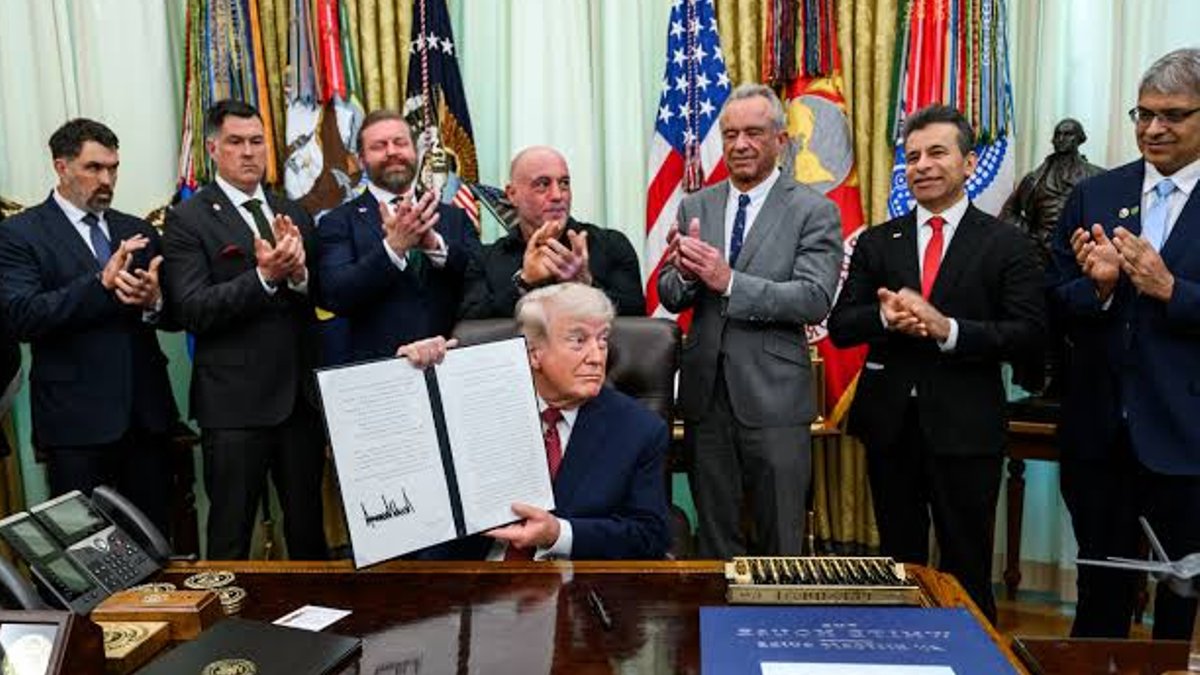
President Donald Trump’s administration scorecard mixes genuine policy actions with several claims that require substantial qualification. The White House says Trump has ended birth tourism, secured more than $2 billion in new mining investments, pushed companies to lower consumer prices, overseen more than 3 million deportations and presided over a manufacturing boom. Some of those claims are supported by government records or corporate announcements. Others use broader definitions than the underlying data, while several important assertions are misleading.
Birthright Citizenship and the Supreme Court
The most significant legal dispute concerns birthright citizenship. Trump did sign two executive orders on Aug. 6 targeting birth tourism and seeking to restrict recognition of citizenship for certain children born in the United States. But the administration’s description of the Supreme Court’s June 30 ruling in Trump v. Barbara is misleading: the Court held that children born in the United States to parents who are unlawfully or temporarily present are citizens at birth under the Fourteenth Amendment’s Citizenship Clause.
The White House said Trump’s Aug. 6 executive orders “end birth tourism” and protect the “meaning and value” of American citizenship. One order addresses birth tourism, while the other directs federal agencies to stop recognizing citizenship in specified circumstances. The orders themselves are not in dispute.
In Trump v. Barbara, the Supreme Court ruled on June 30 that children born in the United States to parents who are unlawfully or temporarily present are “subject to the jurisdiction” of the United States and therefore are citizens at birth under the Fourteenth Amendment. The Supreme Court’s own summary states that conclusion directly. That makes it inaccurate to describe the decision as a ruling that authorized Trump to end birthright citizenship for children of undocumented immigrants or temporary visitors.
Related: Oil holds above 80 despite Iran deal
The administration can argue that narrower categories involving fraud, diplomatic immunity or other exceptional circumstances fall outside the constitutional rule. But that is different from saying the Supreme Court established a general legal basis for ending birthright citizenship. The practical effect of the Aug. 6 orders is therefore likely to depend on further litigation and how federal agencies interpret the categories identified by the administration.
Deportations and Self-Departures
The administration has repeatedly claimed that more than 3 million illegal immigrants have left the United States since Trump returned to office. That number is not the same as saying the administration has carried out 3 million formal deportations. As of June 24, DHS said it had deported more than 948,000 people and arrested more than 981,000. At the same time, the department said more than 3 million unauthorized immigrants had left the United States, including an estimated 2.2 million self-deportations.
Those are different categories. A formal deportation or removal is a government-enforced departure. A self-departure is not a deportation. That distinction matters because the original administration statement describes the entire 3 million figure as “deportations.” The available DHS figures do not support that wording.
The White House has also claimed that no illegal aliens were released into the interior for consecutive months. In February, the administration said the figure had reached nine months. By August, the administration described the period as 15 months. But the phrase should be understood as an administration-specific measure of interior releases, rather than evidence that no undocumented migrant anywhere in the federal immigration system was released during the period.
Related: The Advantages of Partnering with HR Recruitment Agencies
Another figure cited by the White House involves at least 1.4 million ineligible illegal aliens whose benefits were terminated after more than 206 million eligibility checks. The underlying figure is an administration-reported statistic. But “terminated benefits” should not be interpreted as meaning that 1.4 million undocumented immigrants were legally receiving unrestricted federal welfare benefits to which they were entitled.
Mining Investments and Government Financing
The mining portion of Trump’s scorecard is based on real announcements. On Aug. 7, the White House announced more than $2 billion in critical-minerals and mining-related projects. The companies involved include Sila Nanotechnologies, Sunrise Energy Metals and Niron Magnetics, which secured commitments of approximately $1.4 billion, $400 million and $150 million respectively. However, describing these simply as private-sector investments is incomplete.
The financing announced for the three companies includes federal government loans and other government-backed arrangements. A $1.4 billion federal loan commitment is not the same thing as a company spending $1.4 billion of its own cash. The administration’s larger claim that it has facilitated approximately $40 billion across 160 minerals deals should likewise be understood as a tally of investments, financing arrangements and commitments rather than $40 billion already spent on operating mines.
The policy nevertheless represents a major change in the federal government’s approach to critical minerals. Washington is attempting to use government financing, procurement, trade policy and permitting reforms to increase domestic production and reduce dependence on China and other foreign suppliers. The counterargument is that mining projects are capital-intensive and slow to develop. Financing announcements do not guarantee that mines will reach commercial production. Technical problems, permitting, construction costs, commodity prices and financing conditions can delay or derail projects.
Related: Nigeria Election Campaigns Start Early
Grocery Prices and Prescription Drug Discounts
Several retailers have announced price reductions. Giant Eagle, for example, announced a reduction of at least 10% on more than 300 products as part of a summer pricing program. But the administration’s broader claim that retailers are cutting prices across thousands of products because of Trump’s pressure requires more evidence. Retail prices are influenced by competition, promotions, supplier costs, inventories, transportation costs, wages and consumer demand.
A retailer can reduce prices on hundreds of products while prices elsewhere in its stores continue to increase. The distinction is between selected price reductions and a decline in the overall consumer price level. The evidence cited by the administration supports the first proposition. It does not by itself establish the second.
The administration’s prescription-drug claims also contain a real underlying development. TrumpRx currently advertises substantial discounts for certain drugs, including Wegovy. The government website lists discounts of 70% to 85% for some Wegovy injectable products and states that the advertised prices are out-of-pocket prices. The website also lists promotional pricing, including $199 for the first two monthly fills for certain new Wegovy patients, followed by $349 per month under the specified offer.
That makes the original statement’s claim that Novo Nordisk products can be available at roughly $199 to $350 per month broadly supportable. The TrumpRx prices are not universal insurance prices. They can depend on the drug, dosage, number of previous fills and eligibility. The site explicitly describes the listed prices as out-of-pocket prices. The administration’s claim that Pfizer is cutting prices by as much as 85% should therefore be presented as a maximum discount available for particular medicines or circumstances rather than an across-the-board 85% reduction in Pfizer’s drug prices.


